
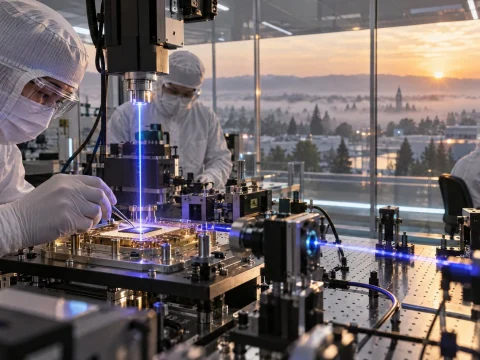
In a clean room on the top floor of Elmbridge University’s physics building, researchers in white suits move between lasers and vacuum chambers. Here, a small team has set a new record in one of the hardest problems in computing: keeping quantum information alive.
The group reported that it kept a set of 24 qubits in a stable quantum state for an average of 1.8 seconds, roughly three times longer than its previous best. The results were published this week after review by independent scientists.
Why stability matters
Ordinary computers store information as bits that are either 0 or 1. Quantum computers use qubits, which can hold a combination of both states at once and can be linked together in ways that have no everyday equivalent. In principle, this allows certain calculations to be done far faster than on any conventional machine.
The catch is that qubits are extraordinarily fragile. Tiny vibrations, heat or stray electromagnetic fields can destroy their quantum state within fractions of a second, a process called decoherence. The longer qubits stay stable, the more operations a machine can run before errors pile up.
The Elmbridge team traps individual atoms with laser beams inside a vacuum and shields them with a redesigned system of magnetic coils and vibration dampers, which the researchers say was the key to the improvement.
We did not build a faster computer. We built a quieter room for the qubits to live in. That sounds modest, but it is exactly what the field needs.
Amara Okonkwo, physicist and leader of the research team








Comments 0