

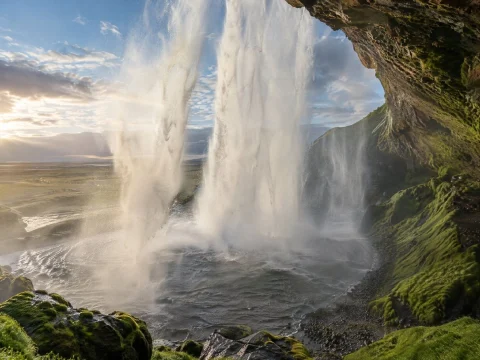
Few places put you as close to falling water as Iceland’s south coast. Along a single road east of Reykjavik, waterfalls drop from the cliffs that once marked the edge of the sea, and at two of them you can step behind the curtain of water or into a hidden mossy chamber. Three days is enough to see the highlights without rushing.
Day one: behind the water
Leave Reykjavik early and drive east on the Ring Road. After about an hour and a half you reach Seljalandsfoss, a slender fall that drops around 60 meters over an overhanging cliff. A path leads all the way around and behind it, where you can look out through the water at the green plain beyond.
Do not stop there. A short walk north along the cliff brings you to Gljúfrabúi, a waterfall half hidden inside a narrow gorge. Step carefully over the stones in the stream and you find yourself in a mossy, echoing chamber with the water crashing down in front of you.
You will get wet. Not a little wet. Bring a waterproof jacket and trousers, and keep your camera in a dry bag between photos.
Freya Halsdottir, a local hiking guide
Spend the night near Skogar, where the broad, powerful Skogafoss is just a few steps from the guesthouses.
Day two: cliffs and black sand
Climb the staircase beside Skogafoss in the morning for a view over the coast, then continue east to the village of Vik. On the way, the black sand beach at Reynisfjara, with its basalt columns and sea stacks, is one of the most photographed places in the country.
It is also dangerous. Sudden, powerful waves can surge far up the beach without warning. Stay well back from the waterline and never turn your back to the sea.
Day three: canyon and ice
The final day takes you further east to Fjadrargljufur, a winding moss-covered canyon with a walking trail along its rim. If you have the energy, continue to the glacier lagoon at Jokulsarlon, where icebergs drift slowly toward the ocean, before heading back west.
Practical tips
- summer gives you almost endless daylight; winter brings ice and short days, so check road conditions every morning
- fuel stations are farther apart than you might expect east of Vik
- stay on marked paths: moss takes decades to recover from footprints
- book accommodation early in high season, as villages along the coast are small





Comments 0