
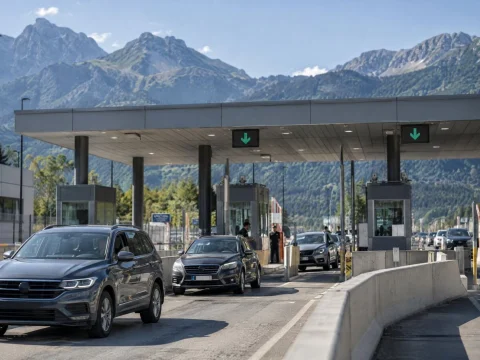
Drivers crossing the mountains of the Northern Region will soon stop only once instead of twice. The interior ministry announced on Tuesday that the country and its northern neighbor have agreed to merge their border controls at four crossings near Greywater, with a single joint checkpoint handling both exit and entry.
The change, which officials say will take effect at the start of the winter season, ends the long-standing system in which travelers were checked by one country’s officers and then, a few hundred meters on, by the other’s. At the busiest crossing, on the Greywater pass road, waits of two to three hours were common on summer weekends.
How the new crossings will work
Under the agreement, officers from both countries will work side by side in shared booths. Passenger cars will be waved into fast lanes where documents are scanned once. Trucks will be able to register their cargo online in advance and receive a time slot for crossing.
For people who live on both sides of these mountains, the border has been a daily obstacle. Now it becomes a formality.
Petra Hollis, state secretary, interior ministry
The ministry says the four checkpoints will be staffed around the clock and that random checks will continue. Number-plate cameras and document scanners were installed over the summer at a cost of about 12 million euros, shared equally by the two governments.
Relief for commuters and haulers
Around 3,500 people commute across the northern border every day, many of them to factories in Northvale or to hotels and ski lifts on the other side. Local business groups have campaigned for faster crossings for years.
Jonas Ferreira, who runs a small transport company in Greywater, said his drivers lose up to a full working day each week in queues. “If this works as promised, it changes our whole schedule,” he said.
Not everyone is convinced. The Green Alliance welcomed the move but warned that faster crossings could bring heavier truck traffic onto narrow mountain roads, and called for limits on night-time freight.
The interior ministry said a joint review will be carried out after six months. If the system performs well, it could be extended next year to two smaller crossings in the Valley Region.




Comments 0