

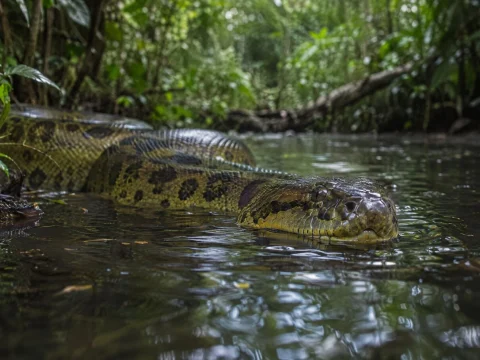
A team of biologists led by Elmbridge University says it has identified a new species of anaconda living in the remote blackwater rivers of a South American rainforest. The snake, which can grow longer than six meters, had been mistaken for a well-known relative for more than a century.
The researchers spent three dry seasons traveling by canoe along tea-colored rivers, taking small tissue samples from wild snakes before releasing them unharmed. Back in the lab, genetic analysis showed that the blackwater animals differ from other anacondas by more than 4 percent of their DNA, a gap large enough to treat them as a distinct species.
Hidden in plain sight
To the untrained eye, the newly described snake looks almost identical to its relatives: olive-green, heavy-bodied, with dark oval spots along its back. Careful measurements, however, revealed a darker belly, a slightly narrower head and spots that rarely join into bands.
Everyone assumed these were the same animals. It took genetics to show us that two lineages had been evolving apart for millions of years.
Dr. Elena Marsh, herpetologist at Elmbridge University and lead author
The team has provisionally called it the “blackwater anaconda.” A formal scientific name will be published with the full species description next year.
Why it matters
Anacondas are top predators in their rivers, feeding on fish, birds, caimans and mammals that come to drink. Splitting one species into two means each population is smaller than scientists thought, and potentially more vulnerable.
The blackwater rivers where the new species lives are under growing pressure from forest clearing, mining upstream and drought. Last year, water levels in parts of the study area fell to the lowest point local guides could remember.
When you discover that a giant has been hiding in plain sight, you realize how much we still do not know about these forests.
Dr. Rafael Montes, river ecologist and co-author
The researchers worked alongside local and Indigenous guides, who had long described differences between the snakes of dark and muddy rivers. The team now plans to fit tracking tags to a dozen snakes to study their range and breeding, and is calling for the blackwater rivers to be included in conservation planning.





Comments 0