

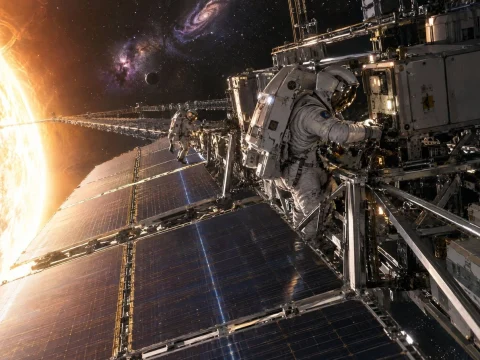
Outside the protective blanket of Earth’s atmosphere, astronauts live with a risk most of us never think about: the weather on the sun. Solar flares and the clouds of charged particles that sometimes follow them can raise radiation levels around a space station within hours.
With the sun still in a busy phase of its roughly 11-year activity cycle, mission teams are paying close attention. Here is how crews are kept safe.
Watching the sun around the clock
Space weather forecasters monitor the sun continuously using observatories in space and on the ground. They track sunspots, flares and eruptions of solar material, and estimate when and how strongly they might reach Earth.
We can’t predict a flare days ahead the way we predict rain, but we can spot the regions most likely to erupt and give crews warning once something leaves the sun.
Dr. Emil Navarro, space weather forecaster at Elmbridge University
Light from a flare reaches Earth in about eight minutes. The most energetic particles can follow within tens of minutes, while slower clouds of solar material take one to three days.
Why spacewalks are the riskiest moment
Inside the station, the walls, equipment and supplies give some protection. During a spacewalk, an astronaut has only the suit. That is why spacewalks are carefully timed, and why mission control can order astronauts back inside if radiation levels begin to climb.
Low orbit itself helps. A station circling a few hundred kilometers up is still partly protected by Earth’s magnetic field, which deflects many charged particles. Missions to the Moon or beyond do not have that shield, which is why radiation protection is one of the biggest challenges for future deep-space travel.
Taking shelter
When a strong solar particle event is forecast, crews move to the most shielded parts of the station, where water tanks, food stores and heavy equipment absorb part of the radiation. Some crews have even built temporary walls of supply bags around their sleeping areas.
Every astronaut also wears a personal dosimeter, and the station carries detectors that measure radiation in real time. Doses are tracked over each astronaut’s whole career, with strict limits.
Not just an astronaut problem
The same storms can disrupt satellites, navigation signals and power grids on Earth, and produce bright auroras far from the poles. Better forecasts protect astronauts and everyday technology alike.





Comments 0