
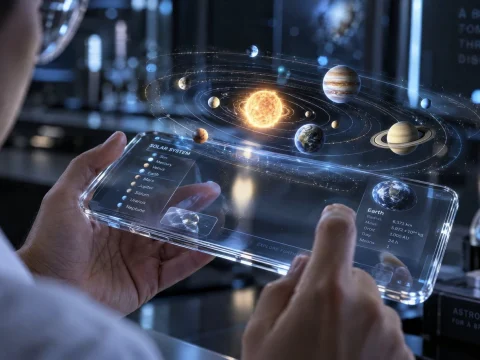
At every major technology fair, the most crowded stands are the ones with screens you can see through, or images that seem to float in the air. The demos are spectacular. But which of these technologies will end up in living rooms and backpacks, and which will remain prototypes? We asked engineers and analysts to sort the real from the wishful.
Transparent screens: closer than you think
Transparent displays already exist. They work by letting light pass through the parts of the panel that are not showing an image, and they are used today in shop windows, museum cases and some vending machines.
A major TV maker has already shown a see-through television that becomes an ordinary dark screen when a shade rolls up behind it. Analysts expect the first consumer models within two years, though at a price only a few buyers will accept.
The physics is solved. The problem is cost and contrast. In a bright room, a transparent screen looks washed out, so you still need a way to make it dark when you watch a film.
Dr. Paulo Mendes, display researcher at Elmbridge University
Transparent tablets: mostly concept art
A tablet you can see straight through, as in science fiction films, is a harder challenge. The battery, processor and camera all have to sit somewhere, and none of them are transparent. Engineers expect designs with a clear window section rather than a fully see-through device.
Holograms: not yet
What most people call a hologram is usually a clever trick: a projection on a fine mesh, a spinning LED fan or a reflection on angled glass. These work well for advertising and concerts, where viewers stand in a fixed spot.
True holographic displays, which show a 3D image you can walk around without glasses, require enormous computing power and very fine light control. Research labs have built small versions, but researchers say a practical screen for homes is at least a decade away.
What to expect in shops
In the near term, buyers are likely to see:
- transparent screens in stores, cars and smart glasses
- 3D displays that track your eyes, so one viewer sees depth without glasses
- brighter, thinner panels that fold or roll away
“The future of displays is less about magic and more about screens that disappear when you don’t need them,” Mendes said.







Comments 0