
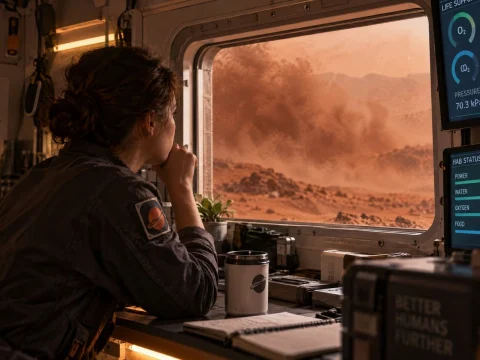
For 365 days, the only view was red. Six volunteers who lived sealed inside a simulated Mars base on a remote, dusty plateau beyond the Greywater mountains stepped outside last week, blinking in the sunlight, after a year cut off from the world.
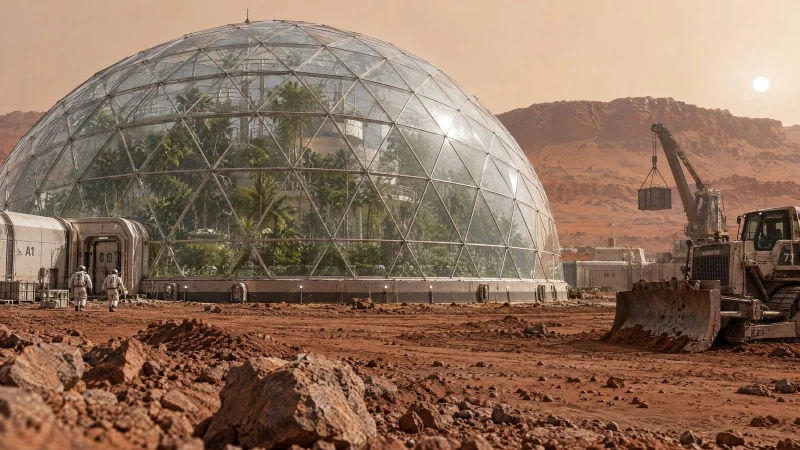
The mission, run by Elmbridge University’s Institute for Space Studies, was designed to study how small crews cope with long isolation, the kind astronauts would face on a real journey to Mars. The habitat, a two-story dome of 160 square meters, had its own greenhouse, laboratory, gym and tiny private bedrooms.
Life with a delay
The crew followed strict rules. Every message to mission control was delayed by up to 20 minutes each way, as it would be between Earth and Mars. They ate mostly shelf-stable food, grew lettuce, tomatoes and herbs, and could leave the habitat only in simulated spacesuits, in pairs.
The delay changes everything. You cannot ask for help and get an answer, so you stop waiting and start solving problems yourselves.
Nadia Ferreira, mission commander and engineer
Their days were full: experiments, maintenance, exercise and “spacewalks” to collect soil samples. The hardest part, several said, was not the work but the sameness. The same faces, the same walls, the same food.
The dust storm
In the fifth month, a real dust storm swept across the plateau for nine days. The sky turned orange, the solar panels lost most of their output and the crew had to ration power, switching off the greenhouse lamps for hours at a time.





Comments 0