
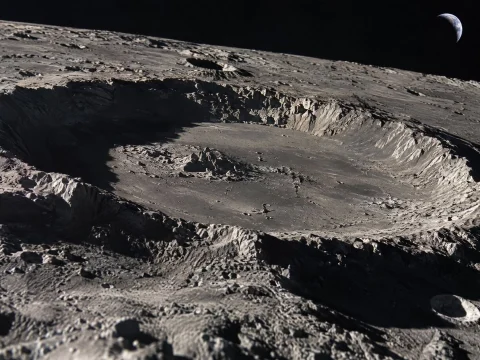
Astronomers at Elmbridge University say they have identified a previously unknown impact crater on the Moon, roughly 160 kilometers across. The basin is so old and so worn down that it is almost invisible in ordinary photographs. Its outline only emerged when the team combined orbital gravity measurements with detailed elevation maps.
The findings were published this week in a peer-reviewed planetary science journal.
How do you miss a crater that big?
The Moon’s surface has been battered for billions of years. Later impacts and ancient lava flows have filled in or broken up many of the oldest craters, leaving only faint traces. The new basin lies in the highlands of the far side, under a patchwork of younger craters.
The team noticed a ring of slightly raised terrain, a few hundred meters high, that matched a circular pattern in the gravity data. Dense rock pushed up from deeper layers during an impact leaves a gravitational signature that can survive long after the visible rim is gone.
It’s like finding the outline of an old building under a modern city. The streets have changed, but the foundations are still there if you know how to look.
Dr. Ingrid Solberg, lead author and planetary scientist at Elmbridge University
Based on how many younger craters sit inside and on top of it, the researchers estimate the basin formed around four billion years ago, during a period when the inner solar system was hit by many large objects.
Why it matters
Large, ancient basins are records of the early solar system. Counting and dating them helps scientists understand how often big impacts happened and how they shaped the young Earth, whose own early craters have long since been erased by plate tectonics and weather.
Independent experts called the result convincing but said more work is needed. “The gravity signal is clear, but the age estimate has wide error bars,” said Rafael Moreno, a planetary geologist who was not involved in the study. “High-resolution imaging of the rim area would help a lot.”
The Elmbridge team plans to search the same data for other hidden basins and has proposed the crater’s central area as a site worth studying by future robotic missions, because the impact may have brought material from deep inside the Moon close to the surface.








Comments 0