
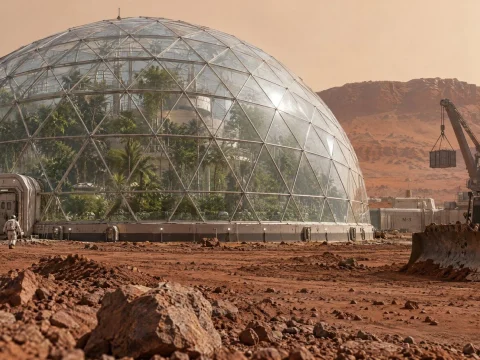
On a dry, rust-colored plateau beyond the mountains of Greywater, a glass dome shines in the sun like something from a science fiction film. Inside, rows of lettuce, radishes and potatoes grow in soil that has been carefully prepared to resemble the surface of Mars.
The greenhouse is run by a team from Elmbridge University, one of several groups around the world testing how astronauts could one day grow their own food on the red planet. A small excavator parked outside moves the iron-rich volcanic soil the team uses to imitate Martian ground.
Why Mars is a hard place to farm
Growing food on Mars would be very different from farming on Earth. The planet’s thin atmosphere offers little protection from radiation, temperatures often fall far below freezing, and sunlight is less than half as strong as here. Any greenhouse would have to be sealed, heated and pressurized.
The soil is a problem too. Studies of the Martian surface have found salts called perchlorates, which are harmful to people and to plant growth. They would have to be washed out before the ground could be used.
Mars soil is not dirt in the way a gardener thinks of it. It has no organic matter, no worms, and chemicals we need to remove. We are learning how to turn it into something alive.
Dr. Ana Sorensen, plant scientist and project lead
What the dome has shown so far
Over two growing seasons, the team has found that leafy greens and radishes grow surprisingly well once the simulated soil is rinsed and enriched with compost made from the crew’s food scraps. Potatoes are slower but produce a reliable harvest. Tomatoes have struggled with the reduced light.
Water has been the biggest lesson. The dome recycles almost all the moisture the plants release into the air, condensing it on cold surfaces and feeding it back to the roots.
Every liter counts. On Mars, you cannot step outside and fill a bucket.
Rafael Holmgren, engineer in charge of the dome’s life-support systems
Benefits back on Earth
The research is not only about space. Methods for growing food with very little water and poor soil could help farmers in dry regions, the researchers say, and the team is already sharing its water-recycling design with vegetable growers in the Valley Region.
Next year the dome will be expanded to test beans and wheat, two crops that would add protein and calories to a future Martian menu.





Comments 0