
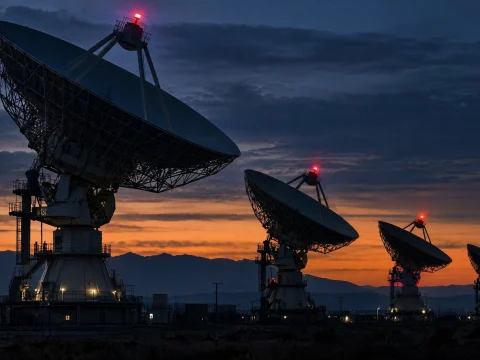
As the sky over the Greywater valley turns orange, the giant dishes of the radio observatory begin to move. Slowly, with a low mechanical hum, they tilt in unison toward a point in the southern sky that, to the human eye, looks completely empty.
To the dishes, it is anything but. They are tuning in to a pulsar, the spinning remains of a dead star, which sweeps a beam of radio waves past Earth hundreds of times every second.
Telescopes you cannot look through
Radio telescopes do not produce pictures the way an ordinary telescope does. Instead, the dishes collect faint radio waves from space and focus them onto sensitive receivers. Computers then turn the signals into data, maps and, eventually, images.
Because radio waves pass through clouds and are not drowned out by sunlight, radio telescopes can work day and night. The night shift has its own advantage, though: there is less radio noise from human activity.
Many of the signals we catch are so weak that a single phone switched on nearby could drown them out.
Dr. Lucia Brenner, staff astronomer at the observatory
That is why visitors hand in their phones at the gate. The observatory sits inside a radio-quiet zone where wireless devices are restricted, and even the microwave oven in the staff kitchen is shielded.
The night shift
In the control room, night operator Tomas Albrecht watches a wall of screens showing the position of each dish, the weather and the flow of data. Wind is the main enemy; when gusts get too strong, the dishes are turned to a safe position.
Tonight’s plan includes the pulsar, followed by a survey of hydrogen gas in a nearby galaxy. Hydrogen, the most common element in the universe, gives off radio waves at a wavelength of about 21 centimeters, allowing astronomers to map clouds of gas that are invisible to optical telescopes.
People imagine astronomers staring through an eyepiece. My night is mostly coffee, checklists and making sure nothing breaks. The excitement comes later, when the data is analyzed.
Tomas Albrecht, night operator at the observatory
What the dishes are listening for
Scientists from Elmbridge University and partner institutes abroad use the observatory to study how galaxies form, to time pulsars with extreme precision and to search for brief, mysterious bursts of radio waves from deep space.
By dawn, the dishes have collected several terabytes of data. Then the sun rises, the dishes swing to their next target, and the listening goes on.








Comments 0